
December 17, 2025
During Advent, Volunteers Bring the Light to Rural New Mexico
By Matt Troyer-Miller
In 2022, New Mexico experienced the largest and most destructive wildfire in the history of the state. It burned 341,471 acres of ground. And if you know anything about wildfires, you know that they are only the first of many successive disasters. With a newly barren landscape, floods become frequent, as there is nothing to slow down or absorb the water. Mudslides are common. The Gallinas River filled up with ash from the fire and killed all the fish. Many area residents had been self-employed, and made a living off their land by logging, or by selling Christmas trees, firewood, and moss rock. Since the land burned, they lost their source of income. Wells were compromised and ruined for rural homeowners. And to make matters worse, the City of Las Vegas, located in northeastern New Mexico, spent nearly three years under a boil advisory, because all that toxic waste left by the fire washed into the Gallinas River and ruined the city’s water filtration systems. Imagine that – almost three years of needing to boil your tap water!
No, that’s the Holy Spirit, would you like to learn more about it?
— Enos Kurtz, A Leader of Restore Our Community Colorado
Nearly two years after the fire, the Federal Emergency Management Agency reached out to me, and I connected them with volunteers from the Mennonite Disaster Service (MDS) Rocky Mountain Unit, as well as volunteers with Restore Our Community Colorado, an MDS partner group made up of Amish, German Baptist, and Mennonites.
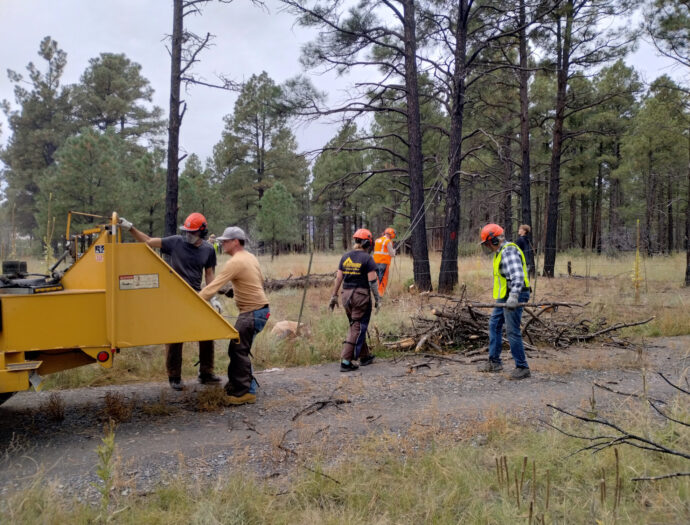
This story comes from their work in rural Guadalupita, New Mexico. Restore Our Community Colorado and the Rocky Mountain Unit have been working in New Mexico for the past two years in response to the Calf Canyon/Hermits Peak Fire. Recently, they worked for Ray and Jolene (not their real names). Ray and Jolene lost everything (including their home, barn, machine shed, leach field, well house and vehicles) in the Calf Canyon/Hermits Peak Wildfire. Then the wind came and blew over the 100-year-old burned-out Ponderosa pines. Then the rains. Then the blizzards – three blizzards that year.
Ray and Jolene are self-helpers, and starting from scratch, built themselves a modest-sized house. But they just couldn’t finish it. They ran out of money, energy, and emotional and spiritual strength. The bathroom was not finished inside (no toilet, shower, sink), and so out of necessity, they used a bucket. It wouldn’t have done any good to finish the bathroom really, since there were no septic lines or septic system either. Their marriage fell apart, as they argued and fought about what to do. Against Ray’s wishes (he is a hardworking and proud man), Jolene reached out for help from Neighbors Helping Neighbors, the long-term recovery group. The long-term recovery group matched the couple with volunteers from Restore Our Community Colorado and the Rocky Mountain Unit. Ray was furious at his wife, for asking for help. He felt ashamed for having failed his family, since he couldn’t do it himself.
Initially, volunteers showed up thinking they would finish the bathroom (toilet, shower, tile, flooring, sink, and painting). But quickly, they realized it would do any good to finish the bathroom, because there were no pipes out of the house and no septic system to run the waste into. One of the volunteers was licensed septic system installer, so volunteers trenched in water and septic lines for the family. Next, volunteers built a “water house” for the family. The family well was slow (like a gallon every two minutes), and it couldn’t keep up with any regular household use. So volunteers brought in a large plastic tank to act as a reservoir, and then built a garage around it. Now the family has running water inside their home! (Imagine, three years with no running water or toilets!)
Jolene was very warm and friendly, but her husband was very disagreeable. Jolene warned Enos Kurtz, one of the leaders of Restore Our Community Colorado, “He may not talk to you. He may be rude. He is just a very different person since the fire.” Sure enough, that was the case. Early in the week, the project was nearly derailed when the husband started yelling at some of the volunteers and demanded that they leave immediately. Everyone stopped what they were doing and looked at Enos, who wasn’t sure how to handle it. So, he told everyone to pack up and head home for the night. When he was back at base camp, Enos spent time in prayer, asking God to make a way where there was no apparent way.
The next day, the husband was a completely different man. He shared about the shame and sense of failure he carried after the fire, and how that affected all his relationships. He apologized for what he had done, and was friendly, helpful, and curious. He asked for prayer, and so everyone had prayer time with him.
Jolene came up to Enos when Ray wasn’t around and said, “I can’t explain it. There was a warmth in the house last night. It had been cold and dark ever since the fire, but last night it was warm and welcoming. Did you bring it?” Enos said, “No, that’s the Holy Spirit, would you like to learn more about it?” And when she agreed, he was able to share about God’s love.
Afterwards the caseworker said something along these lines: “As amazing as it is that you were able to provide running water and a wastewater system to these two, what’s most amazing is the transformation in the way they speak to each other. The marriage may survive, after all.”
It’s the Advent season, and during Advent we celebrate the “light that shines in the darkness, and the darkness cannot overcome it.” Volunteers, through their willingness to serve, allowed the light of hope to shine in Ray and Jolene’s life together. As believers, may we live in a way that allows God’s hope to shine in the darkness.
Matt Troyer-Miller is MDS Region 3 Operations Coordinator.
News & Stories
Videos